Every Road in Ha Giang Tells a Story: The Pulse of the Karst Plateau
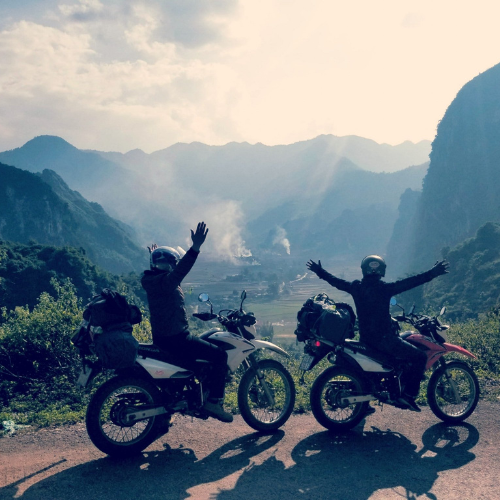
Every road in Ha Giang tells a story of resilience and tradition. Riding the Loop by motorcycle brings you closer to these narratives. The journey unfolds through remote valleys and high mountain passes. Our tour emphasizes safety, respect, and cultural understanding. Knowledgeable guides share insights into local history and life. You’ll ride at a comfortable pace, not rushed. Each day feels like a living documentary. Evenings offer quiet moments to reflect. This is travel with meaning and depth. Ha Giang rewards those who ride with intention.
1. The Prologue written in Stone
In the northernmost reaches of Vietnam, the earth does not lie flat; it screams toward the sky in jagged limestone peaks. To look at a map of Ha Giang is to see a web of grey lines draped over impossible heights. But these are not merely roads. In Ha Giang, the road is a storyteller, a witness, and a monument to human defiance. To travel these paths is to read a history book written in asphalt, sweat, and stone.
2. The Road of Happiness (Hạnh Phúc): A Story of Sacrifice
The most famous story in Ha Giang is that of Quốc lộ 4C, better known as the Happiness Road. The name sounds poetic, but its origin is gritty and heroic.
Built between 1959 and 1965, this road was carved by the hands of over 1,300 volunteers from eight different ethnic groups. They didn’t have heavy machinery or modern drills. They had hammers, crowbars, and dynamite. The story goes that at the “Death Section” of Ma Pi Leng, young volunteers hung from the cliffs with ropes for 11 months, chipping away at the limestone one inch at a time.
Every kilometer of the Happiness Road tells a story of brotherhood. It was built so that the highland people would no longer be isolated, so that salt and medicine could reach the peaks, and so that the “frontier” could finally join the heart of the nation.
3. The Hairpin Turns: A Story of Resilience
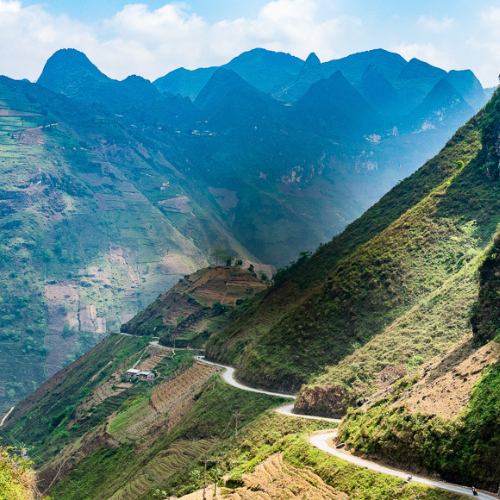
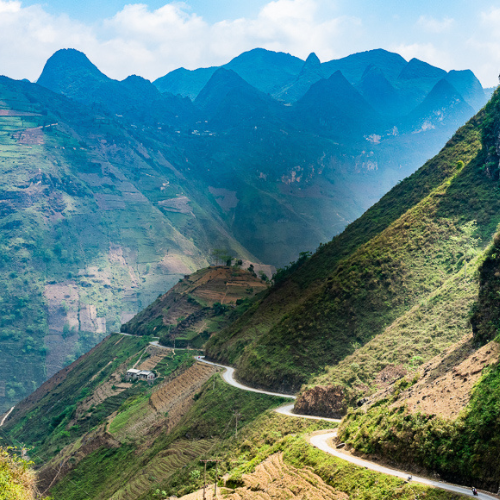
As you climb the Bắc Sum Pass or the Tham Ma Slope, the road begins to coil like a serpent. These 9-turn loops tell the story of the H’mong people’s resilience.
Look closely at the roadside. You will see women carrying heavy baskets of corn, walking uphill with a rhythmic grace that defies gravity. The road tells the story of how life adapts to the vertical. It tells of the “Stone Culture”—where every flat inch of land is used to plant corn, and every rock is a part of a fence. The road is the stage where the daily struggle for survival meets the extraordinary beauty of the landscape.
4. Ma Pi Leng: The Story of the Great Abyss
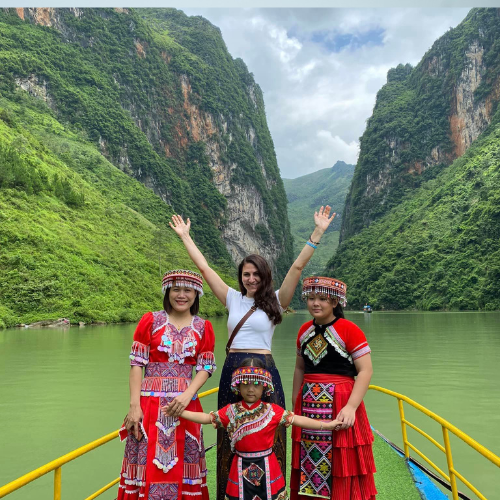
If the road had a climax, it would be the Ma Pi Leng Pass. Here, the road is a thin thread suspended between a thousand-meter wall of rock and a thousand-meter drop into the Nho Que River.
The story here is one of perspective. When you stand at the peak, the road tells you how small you are. It tells a story of the geological time—millions of years of tectonic shifts that pushed these sea-beds into the clouds. The road here doesn’t just connect point A to point B; it connects the traveler to the sublime. It whispers that some things are worth the fear of the height.
5. The Hidden Trails: Stories of the Soul
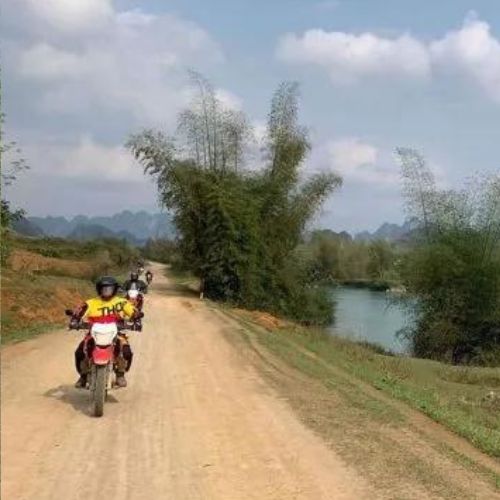
Beyond the main highway lie the “broken” roads leading to places like Du Gia or Lũng Cú. These roads are often dusty, muddy, and narrow. They tell a story of the “unfiltered” Ha Giang.
-
They lead to traditional stilt houses where the smoke of the hearth smells like century-old stories.
-
They lead to hidden waterfalls where the water is as cold as the mountain mist.
-
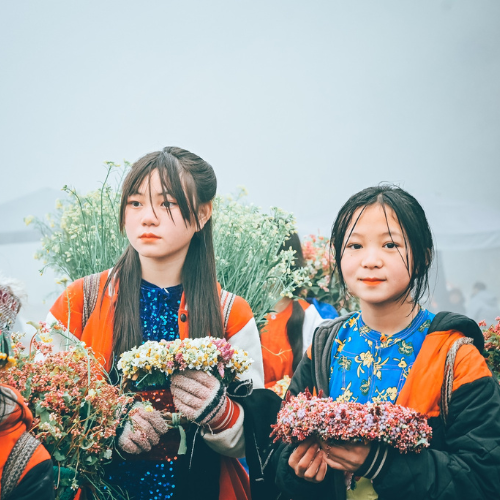
They lead to ethnic markets where the road becomes a colorful tapestry of H’mong, Dao, and Tay people trading silver, textiles, and laughter.
These smaller roads remind us that the journey is more important than the destination. They tell us that the most beautiful stories are often found when we take the wrong turn.
6. The Modern Chapter: A Story of Change
Today, the road is telling a new story—one of tourism and transformation. You see the “Easy Riders” guiding travelers from across the globe. You see the luxury “Cabin VIP” buses bringing comfort to the wilderness.
The road is now a bridge between ancient traditions and the modern world. It tells a story of a Ha Giang that is opening its arms to the world, sharing its “Thắng Cố” soup, its buckwheat flowers, and its rugged heart with anyone brave enough to traverse its curves.
7. Epilogue: The Road Within
When you finally leave Ha Giang, the road doesn’t stay behind. It follows you. You find that the “stories” the road told you have changed your own story.
You learn that “Happiness” is not a destination, but a road built with sacrifice. You learn that even the hardest stone can be carved if you have enough heart. Every turn, every bump, and every cloud-covered peak in Ha Giang is a sentence in a grand epic—a story of how humans and mountains learned to live together.